Across nearly all BC Cancer regional centres, the library offers a welcoming, supportive environment where patients, families and members of the public from across BC and Yukon can ask questions, explore resources at their own pace, and receive guidance from knowledgeable staff – helping them feel more informed, empowered and confident throughout their care journeys.
In September 2025, the BC Cancer – Prince George library officially reopened following major renovations. The project, several years in the making, was supported through special government funding that enabled both the physical upgrade and the addition of a full-time on-site clinical librarian through March 31, 2026. Prince George had been the only BC Cancer centre without a dedicated librarian, making this investment especially significant for the region.
Building access and resources in a rural community
Northern BC and the Yukon are predominately remote and rural regions where many patients may need to travel longer distances to BC Cancer centres and often have more limited access to high-speed internet than those in urban communities. To reduce barriers for users, the library offers free postal delivery of physical materials, as well as access to eBooks and online or print pathfinder guides that feature recommended books, media, websites, and other resources on different cancers and support topics.
Health teams can also refer patients to the library, or patients and families can self-refer themselves using the library’s Information Request Form (IRF). Through the IRF, the library creates customized information packages tailored to the specific type of cancer and treatment or management need identified by the requestor, and delivers them via post or email.
Before and after: A much-needed transformation
Before the renovation and establishment of the librarian position, the PG library was small, difficult to staff, and during the winter months, often cold and uninviting due to its location beside the front entrance. Without a dedicated librarian, reference services were managed remotely from Vancouver. Since the COVID-19 pandemic in 2020, circulation of the library’s physical materials essentially ceased as volunteers were no longer available to facilitate book circulation or handle basic library questions.

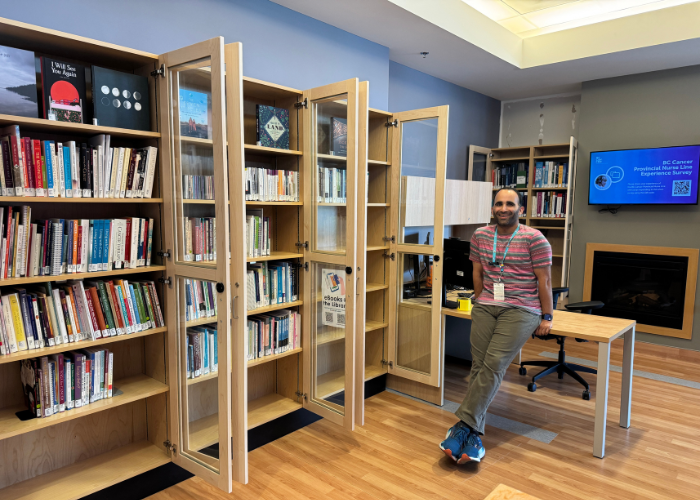
Featured above is librarian David Gill in the old BC Cancer – Prince George library space before the renovations took place.
The renovated library has been relocated to a much larger, previously underused waiting room, nearly doubling its original size. Key features include:
- A relocated library desk, improving visibility of guests for staff and volunteers
- More efficient and accessible shelving units to accommodate both patient and staff collections, with room to grow. A fireplace to create a warm and welcoming space


Featured above is the library space before and after renovation at BC Cancer – Prince George.
Previously, staff resources were stored in the University Hospital of Northern B.C. Library, a 10-minute walk away and accessible only with additional badge access. Now, all staff materials are fully integrated into the Prince George library.
The library will continue to improve the space by adding new tables and seating for patients and staff.
Strengthening Indigenous partnerships
Indigenous Patient Navigators (IPNs) and Indigenous Elders will have a dedicated space next to the new library, and the library seating area will be shared collaboratively with their teams. IPNs provide support and advocacy for Indigenous patients by facilitating and coordinating access to health care services, addressing cultural and spiritual needs, and networking with Indigenous and non-Indigenous health system and community partners.
The library will also continue to work closely with Indigenous partners to strengthen its Indigenous collections.
To foster a sense of collaboration, warmth and welcoming in the space, Indigenous art panels will be installed on the upper walls of the library.
Supporting local news through library resources and services
Patient resources
Library services and the collections curated for patients, families, and the public provide trustworthy and reliable health information about cancer, treatments and related topics such as symptom management, 2LGBTQIA+ health, coping, nutrition and exercise. This has become essential given the increase in widespread health misinformation in recent years.
Most patient materials are offered in print to reflect patient preference, the limited digital availability of consumer-health titles, and the needs of older users who often prefer physical resources. However, some eBooks for patients and families are also available.
During the first year of the new librarian’s arrival, borrowing at the Prince George library grew from just two loans the year prior to 55 books circulated.
Staff resources
For BC Cancer staff, the library provides literature searches and systematic reviews to support research and clinical decision-making, document delivery of full text articles, educational training opportunities, and AutoAlerts to keep teams up-to-date on emerging evidence.
In the first year of service at BC Cancer – Prince George, the librarian spent 163 hours conducting literature searches – work that would likely have taken staff significantly longer and may have resulted in missed evidence without specialized expertise. By navigating complex information resources efficiently, BC Cancer librarians strengthen evidence-based practice, helping staff integrate research, clinical expertise, and patient values to deliver the best possible care.
Staff materials are available in both print and digital format, though the majority of newer title acquisitions largely consist of e-books and online point of care clinical and eJournal databases.
An evolving role in a world of abundant information
In addition to providing cancer information support, librarians play a key role in helping staff, patients and families use AI tools – such as ChatGPT – appropriately and effectively. They provide guidance on analyzing AI-generated content for reliability and direct users to accurate, evidence-based sources.
Libraries remain essential, despite people having easy access to AI tools and an abundance of online information. Beyond books, librarians negotiate licenses for clinical tools, manage digital collections and guide patients, families and staff in making safe and informed choices. The renovated space strengthens this role by providing a more functional, welcoming environment where staff can better support users’ needs.